Business as usual
Warm and familiar, but increasingly hard to defend without stronger controls.
 ANONEMO
from
ANONEMO
from 
For schools
Schools do not have to choose between showing everything and showing nothing. The more useful question is how to keep communications warm and authentic while reducing avoidable risk.
Core idea
Anonemo is designed for the middle ground: real events, real settings and real atmosphere, with identifiable features replaced before public use.
The options
Warm and familiar, but increasingly hard to defend without stronger controls.
Low exposure, but weaker for recruitment, trust-building and community storytelling.
Simple and low-tech, but often less human and less emotionally strong.
Low exposure, but parents may question whether the school is showing real life at all.
Reduces identification risk, but source images leave the school-controlled environment.
Preserves genuine moments, lowers face-based exposure, and keeps normal processing offline and on-premises.
Why the middle ground matters
Schools still need real atmosphere in public-facing communications. Parents, prospective families and communities respond to genuine school life, not just buildings or stock images.
At the same time, public pupil images can now be scraped, copied, altered and reused in ways schools cannot control. A 100% offline, on-premises anonymisation workflow offers a more careful way to keep telling the real story.
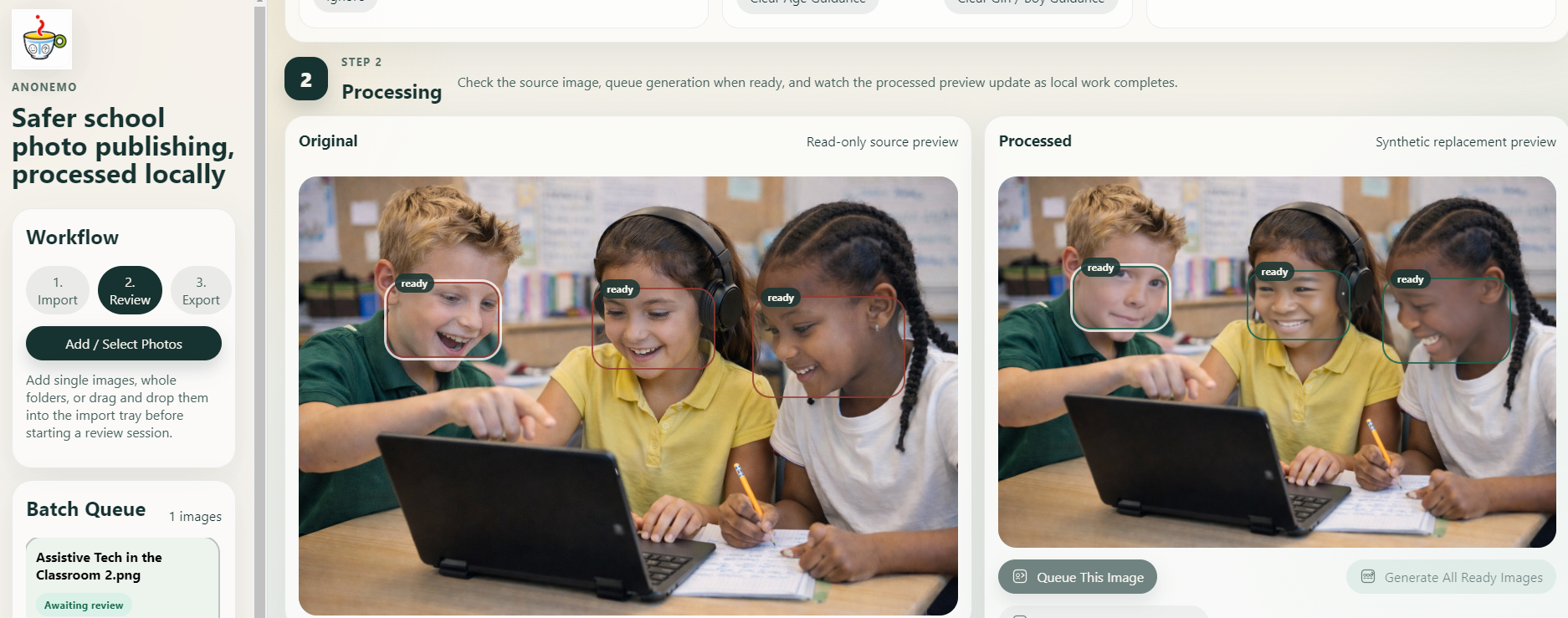
Preview example
This preview shows what the process looks like in practice.
Common worries
Because the risk environment has changed. Public pupil images can now be scraped, manipulated and reused at scale in ways that are increasingly difficult to control after publication.
Some schools may decide that is proportionate. For others, it weakens recruitment, warmth and trust by making communications feel distant from real school life.
That avoids showing real pupils publicly, but it may feel false. Parents may reasonably ask whether the imagery reflects actual school life or an invented version of it.
No. Human review remains essential because pupils may still be identifiable through uniforms, captions, locations, timing, accessories or context.
No. The product is being built as a 100% offline, 100% on-premises workflow so schools can keep the normal review and generation process on a school-controlled device rather than sending pupil photos to a cloud service.
Yes. Schools can use defaults so the workflow applies a consistent approach automatically, with image-level overrides available where a particular photo needs different handling.
Schools can set the balance they want for different situations, including how much of the head is replaced and how different the protected face should appear from the original.
No. Some edge cases still need judgement. Unusual lighting, awkward angles, instruments, props, overlapping people, or partially obscured faces can still produce results that do not look good enough. The workflow allows rerolling one face at a time or switching that face to blur, but some images are still better solved by blur, crop, or choosing a different photo.
Yes. Reviewers can adjust detected boxes more precisely so the protected result fits the image better, while keeping the workflow practical for day-to-day school use.
Decision prompts
Which risk worries us more: identifiable pupils in public, weaker storytelling, or sending source images off-site?
If a pupil could not safely appear on the public website tomorrow, would our current workflow catch that?
What kind of imagery still feels genuine while reducing avoidable exposure?
If there were a complaint or concern, could we explain the chosen workflow as careful and defensible?